
Students
The Barton Reading & Spelling System can help a variety of individuals,
provided the student passes our
10-minute Student Screening.
Who Can Be a Student?
Student Screening
What Students Say
Frequently Asked Questions
Who Can Be a Student?
To ensure the best results, students should meet the following requirements before
beginning the Barton Reading & Spelling System, including passing Barton Student Screening.
Age and Grade
- At least 5 years old.
- In Kindergarten or higher.
Language Skills
- Must speak and comprehend spoken English.
- Not for children with a receptive or expressive language disorder.
- This is also not an ESL program. A non-native English speaker must be able to speak and understand spoken English at a second grade level.
Read about ESL Screening
Cognitive Ability
- IQ of 71 or higher.
Learning Challenges
- Struggles with spelling when writing stories, and cannot easily sound out unknown words when reading.
- Can pass our Barton Student Screening.
What Students Say
Hear from Laura Busby
an adult student
and now Professional Tutor
Student Screening
Is my student ready?
1
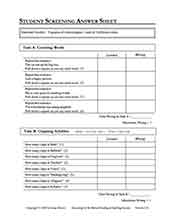
Print the Scoring Sheet
Click here to see, and then print, our 2-page scoring sheet.
⚠️You cannot give or score the Student Screening if you have not passed our Tutor Screening.
⦿ If you have not yet taken our 5-minute Tutor Screening, take it now.
2
Create Colored Squares
The student will need 9 objects, 3 each of 3 different colors.
You can use:
3 red, 3 white and 3 blue poker chips or other game tokens
1 inch by 1 inch squares cut out of colored construction paper, buttons or any other small objects

The specific colors don’t matter, as long as the student has 3 each of 3 different colors.
3
Watch the Student Screening
The Student Passed
The Student did NOT Pass
What needs to happen next depends upon which part of the screening the student had trouble with.
Failed Part A
The good news is that your student does NOT have significant auditory discrimination difficulty.
Your student is just missing some basic knowledge about big chunks of sound – words and syllables.
It could be due to some slight difficulty with auditory processing, or due to lack of instruction.
You can go ahead and start using the Barton System, but for the first 3 to 4 weeks, stop the session about 15 minutes early.
Spend those last 15 minutes teaching the student’s missing skill. There are many ways to teach those skills. So if you work at a school, ask your kindergarten teacher to show you activities they use to teach those skills. Then adapt them to be age appropriate.
If you do not have a teacher to ask, and your student did not do well in Part A of our student screening, contact us to request free activities that you can use to teach your student how to count words in sentences.
If your student did not do well in Part B of our student screening, click here to see many free activities that you can use to teach students how to become aware of, and clap, syllables.
If you do those activities for 15 minutes at the end of the first 8 to 14 tutoring sessions, your student will master those two basic skills.
Failed Part B
The good news is that your student does NOT have significant auditory discrimination difficulty.
Your student is just missing some basic knowledge about big chunks of sound – words and syllables.
It could be due to some slight difficulty with auditory processing, or due to lack of instruction.
You can go ahead and start using the Barton System, but for the first 3 to 4 weeks, stop the session about 15 minutes early.
Spend those last 15 minutes teaching the student’s missing skill. There are many ways to teach those skills. So if you work at a school, ask your kindergarten teacher to show you activities they use to teach those skills. Then adapt them to be age appropriate.
If you do not have a teacher to ask, and your student did not do well in Part A of our student screening, contact us to request free activities that you can use to teach your student how to count words in sentences.
If your student did not do well in Part B of our student screening, click here to see many free activities that you can use to teach students how to become aware of, and clap, syllables.
If you do those activities for 15 minutes at the end of the first 8 to 14 tutoring sessions, your student will master those two basic skills.
Failed Part C
This means that your student is NOT ready for the Barton System – or any other Orton-Gillingham-based system.
Your student is having significant difficulty with either Auditory Discrimination or Auditory Memory. Those are both critical skills that must be improved FIRST.
When the skills have been improved, give your student the Barton Student Screening again. Once the student can pass it, then you can start using the Barton System.
How to Improve These Skills?
There are 2 programs that will improve those skills.
One program, called Foundation in Sounds, was released in 2016. Like the Barton System, all of the training you need comes on video, along with scripted lesson plans, and free unlimited support. So parents, teachers, and tutors can easily learn and use this program. To learn more about it, go to www.FoundationInSounds.com or call the developers, Rick or Lisa Weaver, at 719-476-0189.
The other program, which is research-based, is the Lindamood-Bell program called LiPS. But LiPS is not a “parent-friendly” program. You would need to hire an experienced LiPS professional — someone who has completed the 3-day LiPS training course offered by Lindamood-Bell, and who has years of experience using that program.
A student needs to be tutored one-on-one, at least twice a week, by someone who has professional training in, and lots of experience using, the LiPS program.
The student does NOT have to go all the way through the LiPS program. But they need to stay in the LiPS program until the student has been taught all of the brothers and cousins, the vowel circle, and can “track 3 sounds in a simple CVC syllable” and find the sound that’s different in a chain of 10 CVC nonsense words. Any well-trained LiPS tutor will know what that means.
How to find a LiPS tutor?
Call our office at 408-559-3652. If we know any Certified Barton Tutors in your area who have professional LiPS training and years of experience using it, we will give you their names and phone numbers.
Also, many speech-language therapists have been trained in LiPS. So ask the speech-language therapist at your local public school if she has been trained in LiPS. If so, ask if she could be hired to tutor your child after school.
If she doesn’t know LiPS, ask if she can refer you to someone who does – or a call some other local schools.
Or do a Google search for Speech-Language Therapist followed by your city and state.
Or call your state branch of the International Dyslexia Association and ask if any of their members tutor using the LiPS program. To find your state branch, go to www.eida.org or call them at 800-ABCD-123.
Once a student can “track 3 sounds in a simple CVC syllable” and find the sound that’s different in a chain of 10 CVC nonsense words, give that student Part C of our Student Screening again. If the LiPS tutor has done a good job, the student should now be able to pass our Part C with flying colors – and can then start the Barton Reading & Spelling System.
Get Started
The Barton Reading & Spelling System provides a proven path to literacy success.
Lessons Available
Students Helped
Years Experience
Bright Solutions for Dyslexia, Inc.
Publisher of the Barton Reading & Spelling System.
For more information about dyslexia, visit BrightSolutions.us →